



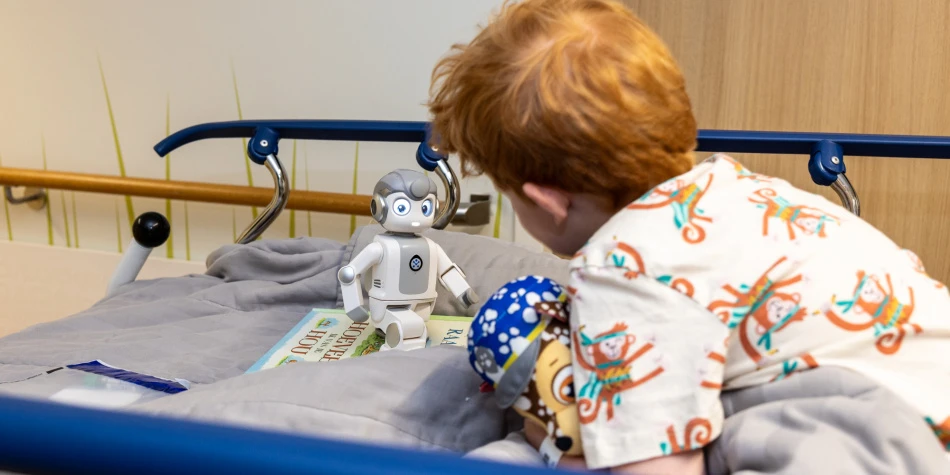
How the Dream Robot helps imaginative children get through challenging moments
A jab, a tube, or going under anaesthetic: many children find these things nerve-wracking. A new research project is working on a unique solution: the Dream Robot. This robot distracts children through guided imagery. This is a proven method whereby a child can relax through a positive story.
The Dream Robot can move, talk and listen. It looks at children, waves and tells stories in a calm voice. Arine Vlieger, a paediatrician at St. Antonius and an expert in guided imagery, explains: “Fear often plays just as big a role as the procedure itself. If you can reduce that anxiety, the whole experience becomes more bearable. For the child, but also for parents and healthcare providers.”
What is guided imagery?
Guided imagery – also known as medical hypnosis – is less daunting than it sounds. It’s all about focus and suggestion. Arine explains: “When a child imagines something vividly, the body reacts to it. For example: the child listens to a story about swimming underwater and sees all sorts of little fish in their imagination. Then the robot says that sometimes little fish might swim up against your nose. At that very moment, the probe is inserted. The child feels the ‘little fish’ instead of the medical procedure. That’s how the brain and the body work together.”
Guided imagery has been used in hospitals for some time, including by medical educators. However, they cannot always be present during every stressful moment. The Dream Robot project is investigating whether this support can also be provided by a robot.
A tailor-made story
Three versions of the Dream Robot have been created, for different medical situations: blood tests, tube insertions and anaesthesia. Arine helped develop the stories that the Dream Robot uses. “The child chooses a pleasant setting themselves, such as the beach or a hot-air balloon, and builds a story together with the robot,” explains Arine. “For children undergoing anaesthesia, the child first meets the robot in the day surgery unit. The robot accompanies them to the operating theatre and continues telling the story calmly whilst the anaesthetist puts the mask on. Because the child chooses the story themselves and is actively involved in it, the moment of the procedure is less stressful.”
Initial feedback is positive
“We noticed that the children taking part in the research project were completely absorbed by the Dream Robot and fully focused on the story it was telling. Even when someone walked in, they didn’t look up or turn around. Staff and parents also reacted enthusiastically,” says Simone de Droog enthusiastically. Simone is an Associate Lecturer in the Digital Life research group at Amsterdam University of Applied Sciences and the project’s principal investigator. “Parents noticed that their child was relaxing, and that made them feel calmer too.”
The test also highlighted areas for improvement. For example, the robot’s volume was too low, particularly for children who have ear tubes fitted.
Cooperation between hospitals
The Dream Robot is a collaboration between Amsterdam University of Applied Sciences, Utrecht University of Applied Sciences, St. Antonius Hospital, Wilhelmina Children’s Hospital, Beatrix Children’s Hospital, Erasmus MC and various robotics and hypnosis experts.
The project has been running for two years and is nearing completion. All the findings are now being collated and incorporated into a step-by-step plan for implementation. Following this, a grant will be applied for to ensure that children experience far less anxiety in hospital in the future.
This article has also been published on the website at St. Antonius Hospital.