



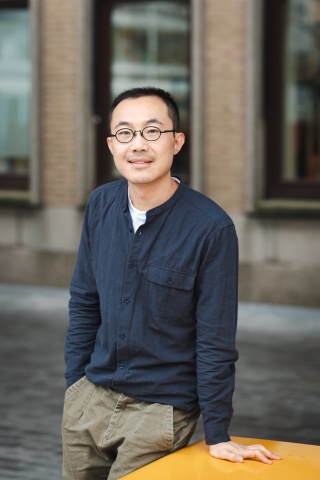
Associate Lector Interaction Design for Emerging Technology
Bin is een designonderzoeker gespecialiseerd in Human-Computer Interaction (HCI) en gezondheidstechnologie. Met een multidisciplinaire achtergrond in biomedische technologie, industrieel ontwerp en HCI, brengt hij een unieke invalshoek in zijn werk. Na zijn promotie in 2018 aan de TU Eindhoven, waar hij onderzoek deed naar biofeedbacktechnologieën voor stressmanagement, werkte hij bij Philips Design aan interactieve datavisualisaties en AI-samenwerkingen in de gezondheidszorg. Sinds 2022 is hij universitair docent en onderzoeker binnen Digital Life, waar hij zich richt op mensgerichte AI en HCI-ontwerp voor datagedreven systemen in de medische sector. Bin onderzoekt technologieën die welzijn bevorderen en AI-oplossingen die klinische workflows verbeteren, met als doel gezondheid en samenwerking tussen AI en clinici te optimaliseren.
e-mail: b.yu@hva.nl
Projecten
Publicaties
Bin Yu, Lân Nguyen, Tianqin Lu, Somaya Ben Allouch
MindFeed: Leveraging Social Media for AI-assisted Reflective Journaling Proceedings Article
In: pp. 1-12, ACM, 2026.
@inproceedings{nokey,

title = {MindFeed: Leveraging Social Media for AI-assisted Reflective Journaling},

author = {Bin Yu and Lân Nguyen and Tianqin Lu and Somaya Ben Allouch},

url = {http://digitallifecentre.nl/wp-content/uploads/2026/05/Publication-MindFeed-BinYu_2026.pdf},

doi = {https://doi.org/10.1145/3786995.3787053},

year  = {2026},

date = {2026-05-06},

urldate = {2026-05-06},

number = {9},

pages = {1-12},

publisher = {ACM},

abstract = {Reflective journaling has long been used as a method to enhance self-insight, emotional resilience, and mental well-being. However, traditional guided journaling tools that rely on standardized prompts often lead to reduced engagement and motivation in daily use. This study presents MindFeed, an AI-assisted reflective journaling tool that generates personalized journaling prompts based on users’ own social media content. The system combines three core models, including BLIP-2 for image captioning, RoBERTa for emotion classification, and GPT-4 for prompt generation, to transform user-generated Instagram or Snapchat stories into personally relevant journaling prompts to facilitate self-reflection. A user study (N = 20) compared MindFeed with a traditional guided journaling tool. The results showed that the AI-generated prompts matched traditional ones in engagement but varied in their ability to elicit deep personal insight. The qualitative results highlighted that prompt clarity, openness, alignment, and perceived authenticity were key factors influencing the user experience.},

keywords = {},

pubstate = {published},

tppubtype = {inproceedings}

}
Chuyang Zhang, Bin Yu, Yuchao Wang, Mansi Yuan, Wanqi Wang, Seungwoo Je, Pengcheng An
ASafePlace: User-Led Personalization of VR Relaxation via an Art Therapy Activity Proceedings Article
In: pp. 1-24, ACM, 2026.
@inproceedings{nokey,

title = {ASafePlace: User-Led Personalization of VR Relaxation via an Art Therapy Activity},

author = {Chuyang Zhang and Bin Yu and Yuchao Wang and Mansi Yuan and Wanqi Wang and Seungwoo Je and Pengcheng An},

url = {http://digitallifecentre.nl/wp-content/uploads/2026/05/Publication-A-Safe-Place_BinYu-2026.pdf},

doi = {https://doi.org/10.1145/3772318.3790571},

year  = {2026},

date = {2026-04-13},

urldate = {2026-04-13},

number = {1564},

pages = {1-24},

publisher = {ACM},

abstract = {To overcome the lack of deep personalization in standard biofeedback methods, we introduce ASafePlace, a system utilizing an AI-powered, art-therapy-inspired exercise called The Safe Place, to create a personalized VR biofeedback experience. In our system, users sketch a personal sanctuary from memory, which is then transformed into a customized 360° virtual environment with personalized audio guidance for relaxation training. A study with 52 participants showed this approach effectively reduced anxiety and increased user presence, while the integration of art-therapy-inspired activity and biofeedback produced strong improvements in physiological relaxation, measured by heart rate variability and respiration rate. Qualitative results showed how participants’ sense of familiarity and presence was enhanced by the symbolic elements and natural sanctuaries created from their autobiographical memories. Our findings demonstrate that art-therapy-inspired activity is a powerful tool for creating highly effective and individualized relaxation experiences, naturally connecting the virtual environment to a user’s core memories and emotions.},

keywords = {},

pubstate = {published},

tppubtype = {inproceedings}

}
Qi Wang, Yifan Yan, Shiwen Fang, Qingfan An, Xiujia Luo, Jie Jia, Bin Yu
CoBreath: Designing a VR-Based Dyadic Biofeedback System to Support Breathing Exercise for Breast Cancer Survivors Honorable Mention Proceedings Article
In: pp. 1-20, ACM, 2026.
@inproceedings{nokey,

title = {CoBreath: Designing a VR-Based Dyadic Biofeedback System to Support Breathing Exercise for Breast Cancer Survivors},

author = {Qi Wang and Yifan Yan and Shiwen Fang and Qingfan An and Xiujia Luo and Jie Jia and Bin Yu},

url = {http://digitallifecentre.nl/wp-content/uploads/2026/05/Publication-Co-Breath_Bin-Yu-2026.pdf},

doi = {https://doi.org/10.1145/3772318.3791096},

year  = {2026},

date = {2026-04-13},

urldate = {2026-04-13},

number = {1566},

pages = {1-20},

publisher = {ACM},

abstract = {Chronic stress and anxiety severely affect breast cancer survivors’ (BCSs) mental health and well-being. Peer support has been shown to enhance psychological empowerment, while biofeedback offers a promising approach to improve physiological relaxation through self-regulation. However, few studies explored combining both for BCSs. We conducted a formative study with clinicians and BCSs to identify requirements and preferences for VR biofeedback. Informed by the findings, we proposed a VR-based dyadic biofeedback system, Cobreath, which integrates breathing and heart rate variability (HRV) feedback into a calming virtual environment, allowing two users to practice breathing-focused relaxation simultaneously. Through a clinical user study with ten clinicians and a between-subjects study with 32 BCSs, we demonstrated that Cobreath’s dyadic mode improved biofeedback effectiveness and provided a better user experience compared to the individual mode. We further discuss insights and design considerations for developing dyadic VR-biofeedback applications to support the mental well-being of BCSs and potential applications.},

keywords = {},

pubstate = {published},

tppubtype = {inproceedings}

}
Tianqin Lu, Bin Yu, Juna Hu
HealthClockface: Design of Glanceable Health Data Visualization for Smartwatches Conferentie
DRS Design Research Society, 2025.
@conference{nokey,

title = {HealthClockface: Design of Glanceable Health Data Visualization for Smartwatches},

author = {Tianqin Lu and Bin Yu and Juna Hu},

url = {http://digitallifecentre.nl/wp-content/uploads/2026/05/Publication-HealthClockface_-Design-of-Glanceable-Health-Data-Visualization-2025.pdf},

doi = {https://doi.org/10.21606/iasdr.2025.583 },

year  = {2025},

date = {2025-12-02},

urldate = {2025-12-02},

pages = {1-19},

publisher = {DRS Design Research Society},

abstract = {Remote measurement technologies (RMTs) hold promises for health tracking, yet current health data

visualizations in RMTs primarily target data-savvy experts, posing challenges for those with limited

expertise. Although researchers have explored creative visualization methods, they often fall short in

aiding data comprehension and neglect the needs of individuals and informal caregivers. This paper

introduces HealthClockface, a smartwatch clockface that offers a glanceable visualization of health data

using abstract and dynamic visuals generated by chaotic attractors. Designed for non-expert users, the

system translates real-time inputs into ambient, glanceable feedback that supports awareness of one’s

health. The system was developed through an iterative, user-centered design process and implemented

on commercial hardware. User feedback highlighted the aesthetic appeal and engagement of the

visualizations, although some users expressed concerns about the interpretability and clarity of the

abstract visuals, particularly when more detailed information was needed. This paper explores the

potential of using ambient, artistic visualizations for health monitoring and highlights the challenges

related to clarity and interpretability, offering insights for future research and design in remote

measurement technologies.},

keywords = {},

pubstate = {published},

tppubtype = {conference}

}
visualizations in RMTs primarily target data-savvy experts, posing challenges for those with limited
expertise. Although researchers have explored creative visualization methods, they often fall short in
aiding data comprehension and neglect the needs of individuals and informal caregivers. This paper
introduces HealthClockface, a smartwatch clockface that offers a glanceable visualization of health data
using abstract and dynamic visuals generated by chaotic attractors. Designed for non-expert users, the
system translates real-time inputs into ambient, glanceable feedback that supports awareness of one’s
health. The system was developed through an iterative, user-centered design process and implemented
on commercial hardware. User feedback highlighted the aesthetic appeal and engagement of the
visualizations, although some users expressed concerns about the interpretability and clarity of the
abstract visuals, particularly when more detailed information was needed. This paper explores the
potential of using ambient, artistic visualizations for health monitoring and highlights the challenges
related to clarity and interpretability, offering insights for future research and design in remote
measurement technologies.

Mengru Xue, Bin Yu, Jiang Wu, Xu Sun, Peidi Fang, Cheng Yao, Fangtian Ying, Shijian Luo, Sheng Zhang
GlowGrow: Designing an ambient biofeedback system for pregnancy stress management Tijdschriftartikel
In: PLOS One, vol. 20, nr. 6, 2025.
@article{nokey,

title = {GlowGrow: Designing an ambient biofeedback system for pregnancy stress management},

author = {Mengru Xue and Bin Yu and Jiang Wu and Xu Sun and Peidi Fang and Cheng Yao and Fangtian Ying and Shijian Luo and Sheng Zhang},

url = {https://www.digitallifecentre.nl/redactie/resources/publication-glowgrow-2025.pdf},

year  = {2025},

date = {2025-01-01},

urldate = {2025-01-01},

journal = {PLOS One},

volume = {20},

number = {6},

abstract = {Pregnancy can be challenging for women as they experience various physical, psychological, and social changes that can lead to stress and potential mental health concerns. Being neglected in the long-term, sustained stress can increase the likelihood of postpartum depression, which can have significant negative impacts on mothers, families, and society. Therefore, managing stress promptly and maintaining emotional well-being is crucial for pregnant women to give a healthy birth and improve their postpartum life quality. Biofeedback is a secure and effective treatment for anxiety; nevertheless, conventional biofeedback systems often depend on intrusive sensors and require clinician support, thereby restricting their utilization primarily to clinical settings. To address this challenge, in this study, by incorporating biofeedback techniques with wearable sensors, musical displays, and ambient light, we created an immersive biofeedback environment where pregnant women could practice slow-paced resonant breathing to promote relaxation and reduce stress. GlowGrow system has been deployed in a regional hospital’s ante-natal clinic and evaluated by 24 pregnant women regarding its effectiveness and user experience. The results show that GlowGrow, as an effective relaxation intervention, could efficiently guide pregnant women to perform deep breathing and manage physiological stress.},

keywords = {},

pubstate = {published},

tppubtype = {article}

}

Hangcheng Yang, Yuan-An Chan, Bin Yu, Yi-Ping Hung, Panos Markopoulos, Rong-Hao Liang
MindFlow: Breathing-Integrated Progressive Muscle Relaxation with a Full-Body Self-Avatar in Virtual Reality Proceedings Article
In: Proceedings of the 2025 ACM DIS Conference, pp. 1658-1673, 2025.
@inproceedings{nokey,

title = {MindFlow: Breathing-Integrated Progressive Muscle Relaxation with a Full-Body Self-Avatar in Virtual Reality},

author = {Hangcheng Yang and Yuan-An Chan and Bin Yu and Yi-Ping Hung and Panos Markopoulos and Rong-Hao Liang},

url = {https://www.digitallifecentre.nl/download/?file=publication-mindflow.pdf},

doi = {10.1145/3715336.3735713},

year  = {2025},

date = {2025-01-01},

urldate = {2025-01-01},

booktitle = {Proceedings of the 2025 ACM DIS Conference},

pages = {1658-1673},

abstract = {Breathing exercises and Progressive Muscle Relaxation (PMR) have complementary effects, making their integration a common practice among relaxation techniques. While numerous virtual reality (VR) exercises support breathing exercises in self-training, integrating breathing support into PMR in VR presents challenges, including maintaining the user’s sense of presence and ensuring the effectiveness of breathing guidance. In this paper, we present MindFlow, a system design that combines breathing biofeedback with a full-body self-avatar, using mindfulness-based principles to provide effective, breathing-integrated PMR guidance in VR. The system demonstrates effectiveness in enhancing relaxation and reducing anxiety in novice users, based on empirical results from a 24-participant user study, offering generalizable insights for the

design of embodied mindfulness systems and further research on mindfulness support in virtual and mixed reality.},

keywords = {},

pubstate = {published},

tppubtype = {inproceedings}

}
design of embodied mindfulness systems and further research on mindfulness support in virtual and mixed reality.
Pingting Chen, Bin Yu, Xiaoqing Sun, Jiangnan Xia, Xinyu Liu, Xipei Ren
ZooWear: Animal-Inspired Head-Mounted Haptic Interfaces to Augment the Zoo Experience Tijdschriftartikel
In: International Journal of Human–Computer Interaction, pp. 1-26, 2025.
@article{nokey,

title = {ZooWear: Animal-Inspired Head-Mounted Haptic Interfaces to Augment the Zoo Experience},

author = {Pingting Chen and Bin Yu and Xiaoqing Sun and Jiangnan Xia and Xinyu Liu and Xipei Ren},

url = {https://www.digitallifecentre.nl/download/?file=publication-zoowear-animal-inspired-head-mounted-haptic-interfaces-to-augment-the-zoo-experience.pdf},

year  = {2025},

date = {2025-01-01},

urldate = {2025-01-01},

journal = {International Journal of Human–Computer Interaction},

pages = {1-26},

publisher = {Taylor & Francis},

keywords = {},

pubstate = {published},

tppubtype = {article}

}
Tianqin Lu, Qingyuan Lin, Bin Yu, Jun Hu
A systematic review of strategies in digital technologies for motivating adherence to chronic illness self-care Tijdschriftartikel
In: npj Health Systems, vol. 2, nr. 13, pp. 1-17, 2025.
@article{nokey,

title = {A systematic review of strategies in digital technologies for motivating adherence to chronic illness self-care},

author = {Tianqin Lu and Qingyuan Lin and Bin Yu and Jun Hu},

url = {https://www.digitallifecentre.nl/download/?file=publication-chronicillnessself-care2025.pdf},

doi = {10.1038/s44401-025-00017-4},

year  = {2025},

date = {2025-01-01},

urldate = {2025-01-01},

journal = {npj Health Systems},

volume = {2},

number = {13},

pages = {1-17},

publisher = {Springer Nature},

keywords = {},

pubstate = {published},

tppubtype = {article}

}
Jacob Browne, Saskia Bakker, Bin Yu, Peter Lloyd, Somaya Ben Allouch
Trust in Clinical AI: Expanding the Unit of Analysis (nominated for best paper award) Proceedings Article
In: HHAI 2022,Amsterdam, pp. 1-18, 2022.
@inproceedings{nokey,

title = {Trust in Clinical AI: Expanding the Unit of Analysis (nominated for best paper award)},

author = {Jacob Browne and Saskia Bakker and Bin Yu and Peter Lloyd and Somaya Ben Allouch },

url = {https://www.digitallifecentre.nl/download/?file=hhai-2022paper30.pdf},

year  = {2022},

date = {2022-01-01},

urldate = {2022-01-01},

booktitle = {HHAI 2022,Amsterdam},

pages = {1-18},

keywords = {},

pubstate = {published},

tppubtype = {inproceedings}

}